If You Want to Play Games, You Have to Make Games
This post is going to be different than my normal posts in a couple ways. Let me give you the TLDR first in case you want that:
- Me and my kids built some games that you can play on the web. They spoke to my computer to build them, and Claude Code built them.
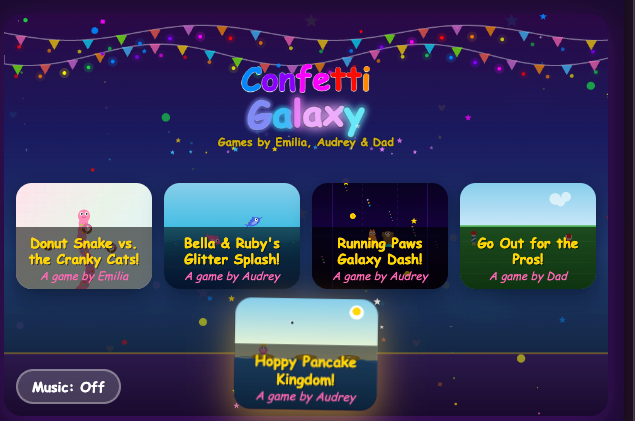
- You can go play them now at confettigalaxy.com.
- I was stunned at how well this works. I am stunned almost every day by the things I am able to do with AI.
- It made me think more deeply about AI, education, and the skills that matter to be successful in society - something that, upon reflection, I’ve been avoiding thinking about.
The Story
My oldest daughter loves to play this online game platform. It’s web-based and has all these different options to play. Some of the games are fun and educational, but some of them are just mindless. I get it, it’s a fun way to use your time and it’s interactive. But there’s been a bunch of friction about her using it and wanting to use it all the time, and a lot of arguing about when she can use it.
I’ve been meaning to think more deeply about what my true view is on AI as it relates to kids. There’s no question that the entire way kids learn is going to have to fundamentally change. There’s also no question in my mind that the current educational systems will always be behind in figuring out how to integrate these new capabilities into learning experiences. AI is accelerating so fast at this point that the gap is just going to continue to get wider.
As someone who’s incredibly deep in this rabbit hole, I took a step back and tried to ask myself - why haven’t I thought more about this? I think it’s because I don’t have a good solution, and I’m worried about how this change takes shape, particularly for younger people. So it’s avoidance.
AI has made a step change in capabilities in the last three months. Things that have taken me weeks in the past now take me hours or even minutes. And it keeps compounding as you build systems to better utilize these tools.
So taking all of that into account - yesterday I had an idea. I told my daughter that if she wanted to play games, then she had to make games. As an eight-year-old who has no idea what AI is, that concept didn’t mean anything. So I had to show her what I meant. I opened up Claude Code with her. I know how to orchestrate this tool very well at this point because I’m in it every day, so we weren’t starting from scratch and I knew the scaffolding we had to set up. I worked with her and then with my other daughter to build games. I used the system in a way that had it ask us questions about what we’re trying to achieve.
It was super interesting because kids are so creative. They have ideas and oftentimes they have trouble describing them exactly, but as you keep asking them questions, they can really clarify their thinking. We worked through this for a while. I set up a little Q&A workflow using a Claude Code skill, but I also had my kids speak to the computer using Mac Whisper and tell their own ideas about the games. Then we had it build the games. I helped with some of the polish and I knew how to make them a little bit more interactive, but most of these games were the kids’ ideas with me asking them questions about what they wanted them to do.
Within an hour they were playing their own games. Then I told them that their friends can play their games too. I spent a little bit more time with Claude Code working on a plan to deploy these games so that anyone can play them. And here they are on confettigalaxy.com.
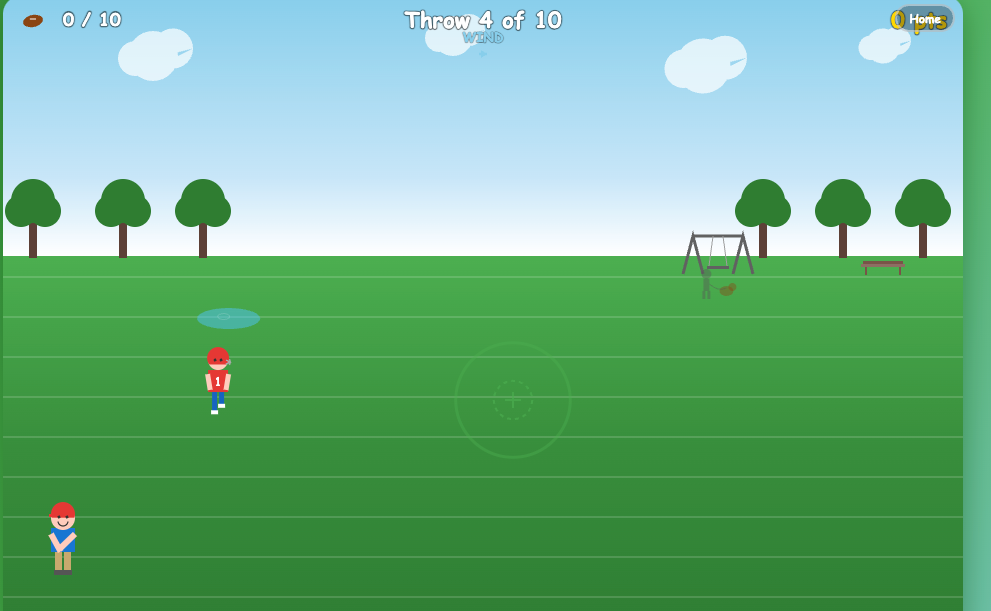
This was so fun that I built my own game afterwards. I built a game called Go Out For The Pros, which is a game I used to play with my dad at the playground. I described the experience using the skill workflow - what we used to do, how it worked - and it built the game. It’s honestly exactly how I remembered it. Absolutely magical.
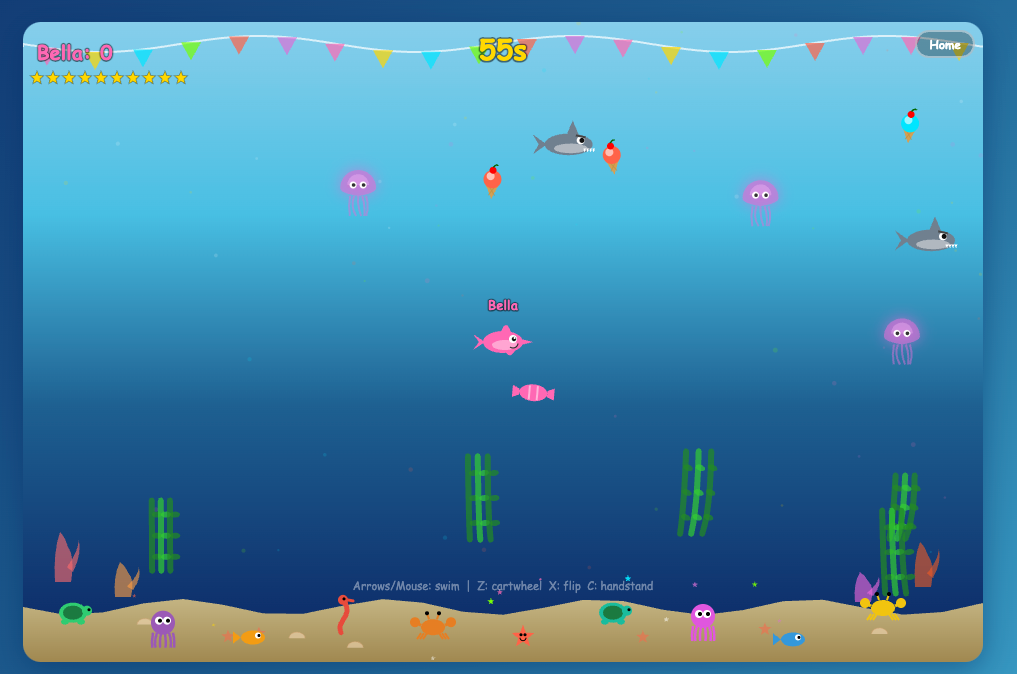
My daughter wanted to build a dolphin swimming game where you swim around and collect candy. She described the whole thing herself and we built it together.
The Jumble of Thoughts
After this exercise, a lot of thoughts came to the surface that have been lingering for a while. I haven’t fully clarified them all, but it felt useful to just write them down. Here they are in their raw form.
Education is going to change
There’s a lot of uncertainty about how AI changes education. Educational systems will always be behind the leading edge, and the gap is only going to get wider. But I think the failure mode is not leaning into it. If you want your kids to understand AI and how it fits into society, I think you have to experiment and do that yourself right now.
The skills that matter aren’t new
A lot of the skills you need to use AI well aren’t new skills. They’re skills that need to be amplified to take full advantage of this new capability. The ones that come to mind most for me:
- Agency. Do you believe that you can create something yourself, and will you be assertive in taking that initiative? This skill has always been rare and incredibly useful. People who know what agency can do and are assertive about it are in an incredible position to take advantage of these new tools.
- Curiosity. Are you willing to think about things and make connections across various topics? Are you learning about things well outside of technology that can impact your viewpoints? Curiosity and making connections has never been more valuable.
- Clear thinking and communication. Can you think through what you’re trying to do and communicate that with clarity? There is a vast difference in outcomes from using these AI tools based on your specificity and your clarity of thought.
- Willingness to iterate. Do you treat things as things that can improve over time? Do you try to nudge things to improve in an incremental fashion? Utilizing these tools effectively truly requires a feedback loop and iteration, and that’s where you get the compounding. You have to be able to analyze what you’re getting back as the result and figure out how to improve it.
- Comfort with discomfort. Can you push through the discomfort of trying something new? Even when it feels odd, can you deal with the change and adapt? Things are moving fast and the people who have the mental models to push through that discomfort instead of retreating from it are going to be in a much better position.
There are other skills that are useful for AI, but those are the top ones that come to mind. None of them are technical in nature. People have been trying to develop these types of skills for years, even before AI. If you want your kids to be able to thrive in what’s coming with this wave of AI, you need to figure out how to help them learn these skills.
These skills are learnable
Building the games yesterday showed me these skills are learnable with the right environment and the right person helping. My probing questions forced the kids to think more clearly about what they wanted, and they rose to it. And one of the big advantages of learning these skills with these tools is the feedback loop is so tight. You describe something, it builds it, and you can see the progress immediately. The kids were amazed by how fast we could build these games and it gave them a ton of energy to think about what else they could do.
These tools are absolutely remarkable
I intellectually know at this point that these things are extremely capable. My mental model has always been to try to throw your most ambitious project at these tools because they will continue to surprise you. But even with that knowledge, I am continually surprised.
This is a portal my kids can use instead of the previous games they were playing. We can build new games together in about 10 to 15 minutes. They can create their own adventure and then play it. We can build games they want to play instead of the mindless games they’ve been playing. And it forces them to utilize the skills I talked about above.
I think people still truly underestimate how remarkable these tools are. They can do stunning things. As someone who’s deep in this rabbit hole every day, I am stunned on a daily basis. I really think people need to see this for themselves. Dig in, try these things. It’s worth carving off time to do so because it is absolutely astounding what they can do.
Equity
Education is going to drastically shift given how these tools can be integrated. Some people are starting to figure this out and take action on it. But the folks who have figured it out already have the means, and the technology and the environment to use it are readily available to them. If you look at something like Alpha School, the results speak for themselves - the improvements in testing outcomes they’re seeing by integrating AI into how kids learn are significant. I think it’s pointing in the right direction. But it’s not accessible to everyone yet, and won’t be for some time.
I’ll be honest - I haven’t spent enough time thinking through how this all plays out at scale. But the opportunity is real. AI enables individually tuned lesson plans in a way that was never before possible, and research on personalized instruction consistently shows it’s more effective than one-size-fits-all approaches. If we don’t figure this out, the disparity in skills and understanding has the possibility to be orders of magnitude greater than anything we’ve ever seen before. How do we democratize access to what I’m talking about in this post in a way that works? How do we ensure as a society that this is available to everyone? I don’t have the answer, but it’s a question we need to be asking.
Where I Landed
I know this is a jumble of thoughts and I haven’t truly clarified them all. But they felt important enough to at least begin trying to clarify my thinking on them. The thread running through all of this for me is just acknowledging how much the world is going to change for our youth because of this technology. There are going to be a lot of decisions that need to be made and things that need to change to make sure we’re taking advantage of these remarkable tools, but doing it in a way that’s fair, equitable, and helps people thrive in society and the economy. I don’t have the answers to all of this. Short term, it’s on me to help my kids adapt, and the earlier I can do that the better off they are. But I’ve committed myself to spend more time thinking about this and figuring out what my role in it is beyond my own family.
On a lighter note, definitely check out the games at confettigalaxy.com because they are pretty fun. And if you’re curious about how you can build these games with your kids, I’ll do a follow-up post that is more technical in nature to show exactly what I did.